


You don’t need a 47-page business plan, a downtown office, or a logo that took three months to approve to start a business.
You need something much more important: a problem worth solving, people willing to pay for the solution, and a practical plan for turning that opportunity into a legitimate business.
Starting a small business in the United States generally involves validating your idea, researching the market, choosing a business structure, registering the business where required, handling tax IDs and permits, separating business finances, arranging funding, and preparing to sell.
The exact requirements depend on what you sell, how your business is structured, and where you operate.
And Americans are still creating businesses at a remarkable pace. The U.S. Census Bureau reported 531,728 seasonally adjusted business applications in August 2026 alone.
That does not mean 531,728 successful businesses suddenly appeared. A business application and an operating business are different things. But it does show the enormous level of entrepreneurial activity taking place across the country.
So if you’ve been waiting for the mythical “perfect time” to start, ask a more useful question:
What would it take to find out whether your business idea actually works?
Quick Answer: How Do You Start a Small Business in the U.S.?
To start a small business in the U.S., first validate that customers want what you plan to sell. Then research your market, define your business model, calculate startup costs, choose an appropriate business structure, register where required, obtain necessary tax IDs and permits, separate your business finances, arrange funding and protection, and launch with a system for measuring results.
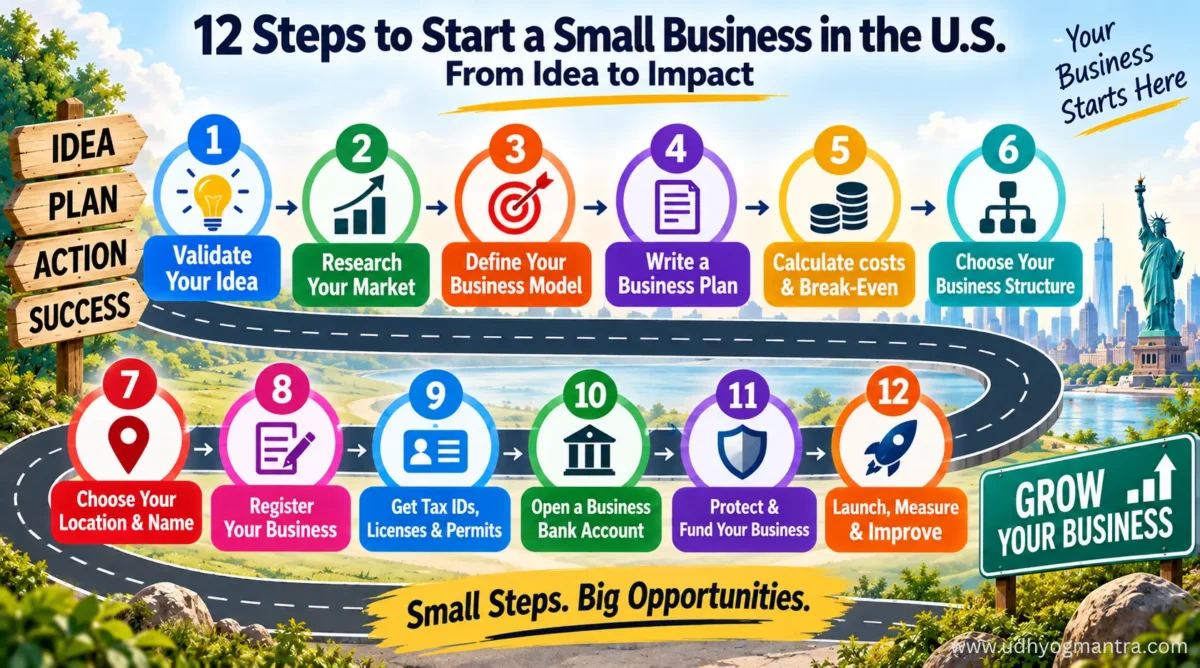
A practical sequence looks like this:
- Validate your business idea.
- Research your market and competitors.
- Define your business model.
- Write a practical business plan.
- Calculate startup costs and break-even point.
- Choose your business structure.
- Choose your location and business name.
- Register your business.
- Get required tax IDs, licenses, and permits.
- Open a business bank account.
- Protect and fund the business.
- Launch, measure, and improve.
That sequence looks beautifully organized on paper.
Real businesses are messier.
You may discover your pricing is wrong while studying competitors. Customer interviews might change your product. Your funding requirements may double after you calculate inventory costs.
That’s normal.
The objective isn’t to complete twelve boxes as quickly as possible.
It’s to reduce uncertainty before expensive assumptions become expensive mistakes.
Before the 12 Steps: Do You Actually Have a Business Opportunity?
There is a big difference between an interesting idea and a viable business.
Suppose you want to launch a subscription service that sends specialty coffee to remote workers every month.
Interesting?
Absolutely.
A business?
Not yet.
Before worrying about an LLC, website colors, business cards, or whether your logo needs a mountain in it, answer some harder questions:
- Who specifically wants this?
- What problem or desire does it address?
- What alternatives are customers already buying?
- Why would someone switch?
- How frequently would customers buy?
- What would they realistically pay?
- Can you acquire customers economically?
- Can you deliver the product at a sustainable margin?
A business idea becomes much more interesting when the answers involve customers, behavior, economics, and evidence rather than enthusiasm alone.
Step 1: Validate Your Business Idea
Validation means gathering evidence that the problem exists and that potential customers care enough about solving it.
This doesn’t necessarily require expensive research.
Start small.
Talk to potential customers. Observe how they currently solve the problem. Study competing products. Read customer complaints and reviews. Create a basic prototype or service offer. Test a landing page. Try to secure a preorder, pilot customer, waitlist signup, or another meaningful commitment.
Be careful with one particularly dangerous piece of market research:
“Would you buy this?”
People are wonderfully generous with hypothetical money.
Behavior is more useful.
Someone saying, “Cool idea!” is weak evidence.
Someone asking, “How much does it cost?” is better.
Someone actually paying is better still.
Use the Four-P Validation Test
Before committing serious money, evaluate four things:
Problem: Is there a meaningful problem, need, or desire?
Person: Can you identify the customer clearly?
Payment: Is there evidence customers will spend money solving the problem?
Practicality: Can you deliver the solution profitably and repeatedly?
If one is missing, keep testing.
This deserves more attention than most first-time founders give it. Before spending heavily on inventory, development, branding, or legal setup, learn how to validate a business idea before you spend real money.
Step 2: Research Your Market and Competitors
Market research should answer two different questions:
Is there enough demand?
And:
Can your business realistically capture some of it?
Start by identifying customer segments, studying competitors, comparing prices, reading customer reviews, and understanding how people currently buy.
For U.S. market research, government sources such as the Census Bureau, Bureau of Labor Statistics, and Bureau of Economic Analysis can provide useful demographic, business, employment, income, and economic information.
But don’t confuse a huge market with a huge opportunity for your company.
“This is a $20 billion market, so we only need 1%” is one of entrepreneurship’s favorite pieces of optimistic arithmetic.
One percent can be extremely difficult to win.
Instead, work from the bottom up.
Ask:
- How many realistic customers can we reach?
- How frequently could they purchase?
- What could the average transaction be worth?
- What might customer acquisition cost?
- What percentage of prospects might realistically convert?
That produces a much more useful estimate than attaching your startup to an enormous industry statistic.
Look for Competitor Weaknesses, Not Just Features
Study:
- pricing
- positioning
- product range
- distribution
- customer reviews
- recurring complaints
- guarantees
- sales channels
- customer experience
- delivery times
- marketing messages
- underserved customer groups
A competitor with hundreds of frustrated reviews may be doing part of your market research for you.

Step 3: Define Your Business Model
A business model explains how your company creates value and makes money.
Two companies can sell essentially the same thing while operating completely different business models.
Software can be sold through:
- monthly subscriptions
- annual subscriptions
- one-time licenses
- usage-based pricing
- freemium plans
- enterprise contracts
A consultant might charge:
- hourly
- by project
- on retainer
- per outcome
- through a standardized service package
Ask seven questions:
- What exactly are we selling?
- Who pays us?
- How much do they pay?
- How frequently do they pay?
- What does it cost to serve them?
- How do we acquire customers?
- Can revenue grow without costs rising at exactly the same rate?
Your business model does not need to revolutionize capitalism.
It needs to make economic sense.
Step 4: Write a Business Plan You Will Actually Use
Traditional business plans still have a role, particularly when lenders, investors, partners, or other stakeholders need detailed information.
But many small businesses don’t need to begin with a beautifully formatted 50-page document.
Your first useful plan can be much leaner.
Document:
- customer problem
- proposed solution
- target customer
- market opportunity
- competitive landscape
- revenue model
- pricing
- sales strategy
- marketing strategy
- operating requirements
- major costs
- financial assumptions
- milestones
- key risks
Treat your plan as a decision-making document, not homework.
A polished 40-page plan built on imaginary assumptions is less useful than a five-page plan that changes when customers teach you something important.
Mini Case Study: Mailchimp Started by Solving a Smaller Problem
Not every major company starts with a grand plan to become a major company.
Mailchimp offers a useful example.
Ben Chestnut and Dan Kurzius started a web design agency called Rocket Science Group. While focusing on corporate clients, they created an email marketing service on the side for small businesses.
Mailchimp says the product was designed as an alternative to the oversized and expensive email software available in the early 2000s.
The company was founded in Atlanta in 2001.
Instead of trying to solve every marketing problem immediately, Mailchimp initially concentrated on email marketing for smaller businesses.
The company also took an unusual financial path for a technology business. Mailchimp described itself as privately owned and bootstrapped without outside investors.
Two decades later, Intuit acquired Mailchimp in 2021. Mailchimp’s official founder profile says the acquisition was valued at $12 billion.
That outcome was exceptional.
But the useful lesson isn’t.
“Build a side project, and someone will buy it for billions.”
That would be survivorship bias wearing a nice suit.
The useful lesson is the sequence.
What Mailchimp’s Early Story Can Teach a New Founder (H3)
Think of it as
Observed problem → narrower solution → real users → continued improvement → expansion
Mailchimp didn’t need to begin as an everything-for-everyone marketing platform.
It started by addressing a more specific problem for a recognizable customer group.
That’s useful for a first-time founder because the temptation is usually the opposite.
You want five products.
Seven customer types.
Twelve features.
Three revenue streams.
And preferably all of them by Tuesday.
A better question is:
What is the smallest valuable version of this business that real customers would pay for?
For a modern founder, that could mean:
- offering the service manually before automating it
- launching one product rather than ten
- serving one customer segment first
- testing one geographic market
- securing five paying customers before investing heavily in infrastructure
Mailchimp’s eventual scale was extraordinary.
The underlying principle isn’t:
Start narrower than your ambition, learn from actual customers, and expand when evidence gives you a reason to.
External source: Mailchimp’s official company history and founder profile.
Step 5: Calculate Startup Costs and Your Break-Even Point (H2)
Now comes the part where enthusiasm meets a spreadsheet.
List everything required to get the business operating.
Depending on your business, startup costs might include:
- formation fees
- licenses
- equipment
- inventory
- insurance
- professional services
- software
- website development
- rent and deposits
- payroll
- marketing
- packaging
- shipping
- payment processing
- working capital
Separate one-time startup expenses from recurring operating expenses.
Then estimate your break-even point.
For a simple unit-based business:
Break-even units = Fixed costs ÷ (Selling price per unit − Variable cost per unit)
Suppose:
Fixed monthly costs = $6,000
Selling price = $100
Variable cost per unit = $40
Contribution per unit:
$100 − $40 = $60
Break-even volume:
$6,000 ÷ $60 = 100 units
You therefore need to sell approximately 100 units per month under those assumptions to cover fixed costs.
Suddenly:
“We need more sales.”
becomes:
“We need approximately 100 sales per month to break even.”
That’s a number you can manage.
If you’re preparing your first financial model, start by learning how to calculate the break-even point for a small business before making aggressive revenue forecasts.
Step 6: Choose Your Business Structure
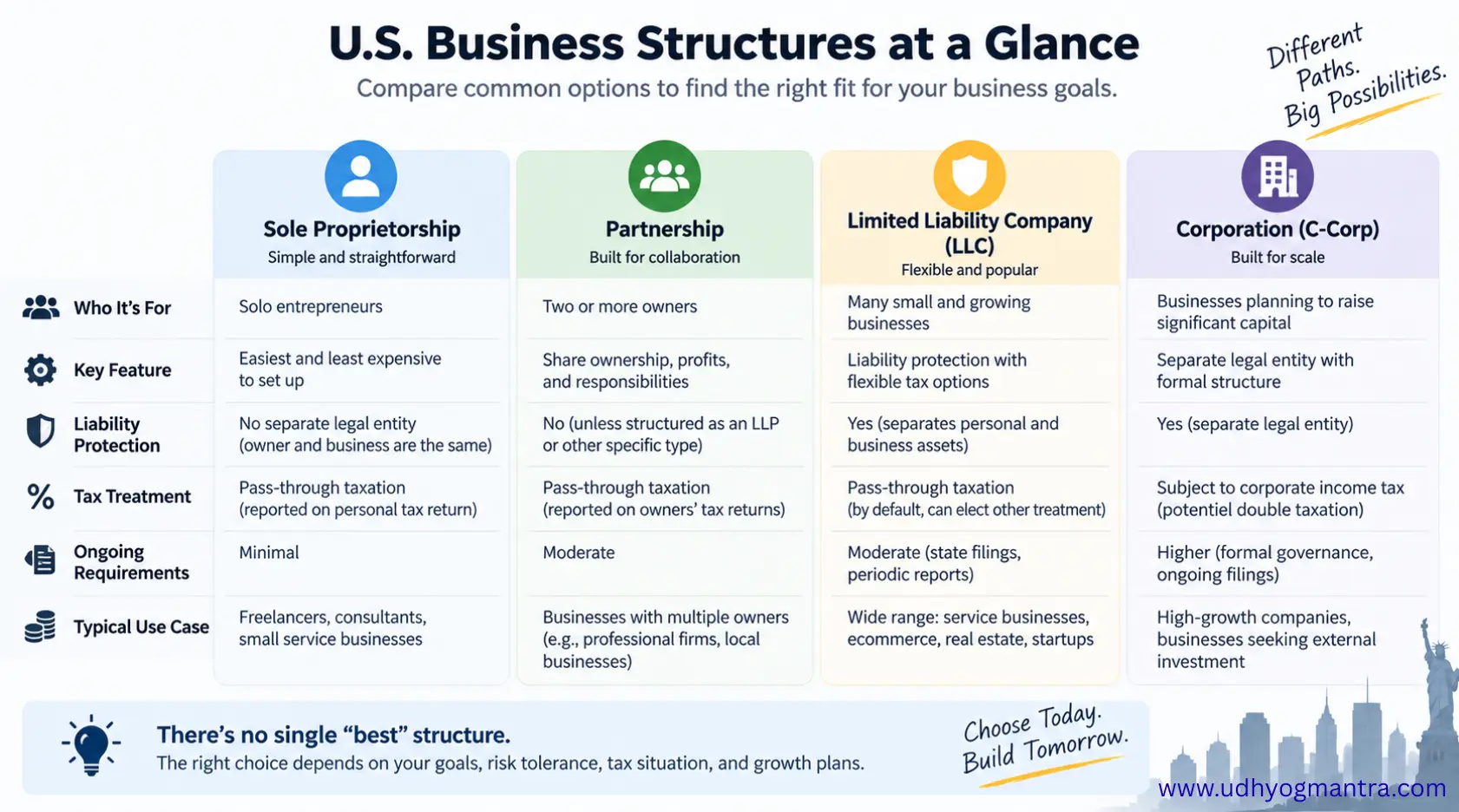
Your legal structure can affect taxation, liability, paperwork, ownership, and your ability to raise money.
Common U.S. structures include:
| Structure | Basic characteristic | Often considered by |
|---|---|---|
| Sole proprietorship | The owner operates an unincorporated business. | Solo operators and very small businesses |
| Partnership | Two or more people conduct business together. | Businesses with multiple owners |
| Limited liability company (LLC) | State-law entity that can provide liability separation and flexible federal tax treatment | Many small and growing businesses |
| Corporation | Separate legal entity with more formal governance | Businesses requiring particular ownership or funding structures |
| S corporation | A federal tax status/election available to qualifying entities | Eligible businesses evaluating specific tax treatment |
There is no universally best structure.
A solo consultant has different priorities from a startup preparing to raise institutional venture capital.
The SBA notes that business structure can affect taxes, fundraising, required paperwork, and personal liability.
Tax consequences can also vary based on the entity, owners, elections, state, and individual circumstances.
For decisions involving meaningful liability, ownership, or tax consequences, consider getting advice from a qualified attorney, CPA, or other appropriate professional.
If you’re deciding between the two structures most commonly considered by solo founders and small operators, our guide to LLC vs. sole proprietorship explains the practical differences in more detail.
Step 7: Choose Your Location and Business Name (H2)
Your location is more than the address printed on your website.
The SBA notes that business location affects matters such as taxes, zoning, and regulations.
That makes location a strategic consideration even when part of your operation is online.
Then there is the business name.
A strong name should ideally be:
- memorable
- reasonably easy to spell
- appropriate for your positioning
- flexible enough for future growth
- available where registration is required
- checked for potential trademark conflicts
Before falling in love with a name, investigate it.
Check relevant state business databases, domain availability, existing companies, and federal trademark records where appropriate.
A domain being available does not automatically mean you have the legal right to use the corresponding brand name.
Step 8: Register Your Business (H2)
How and where you register depends on your business structure and location.
For many businesses, registration happens primarily at the state and local levels.
The SBA notes that some people conducting business under their own legal names may not need the same type of business-name registration, while businesses seeking entity-level protections or operating under other names may have additional requirements.
An LLC or corporation will typically have state formation requirements.
Depending on your situation, you may also encounter:
- DBA or trade-name registration
- state tax registration
- local business registration
- registered-agent requirements
- periodic state reports
- industry-specific filings
Create a compliance calendar as soon as the business is formed.
Record:
- formation date
- annual or biennial reporting deadlines
- license renewals
- tax deadlines
- registered-agent information
- insurance renewals
- other recurring filings
Five minutes with a calendar is considerably cheaper than discovering a missed compliance requirement six months later.
Step 9: Get an EIN, Licenses, and Permits, and Understand Your Taxes
An Employer Identification Number (EIN) is a federal tax identification number assigned by the IRS.
The IRS says an EIN may be required in situations such as hiring employees, operating certain entity types, or filing certain federal tax returns. Banks may also require one to open a business account.
You can obtain an EIN directly from the IRS for free.
Be careful with websites that make a free government process look like an expensive mandatory service.
Licenses and Permits Depend on the Business
A restaurant, trucking company, contractor, financial service, consultant, and retailer won’t necessarily face the same requirements.
Depending on what you do and where you operate, licenses or permits can exist at:
- federal level
- state level
- county level
- municipal level
Don’t treat a generic internet checklist as your final compliance authority.
Verify requirements with the government agencies responsible for your industry and location.
Your Business Structure Also Affects Taxes
Federal business taxes can include different combinations of:
- income tax
- estimated tax
- self-employment tax
- employment taxes
- excise taxes
The IRS states that the form of business you operate determines which taxes you pay and how you pay them.
That makes tax treatment one of the reasons business structure deserves more thought than simply choosing whichever acronym sounds most professional.
Step 10: Open a Separate Business Bank Account
Once business money starts moving, separation matters.
A dedicated business bank account can make bookkeeping cleaner and help separate business transactions from personal finances.
The SBA recommends opening a business account when you’re ready to start accepting or spending money as the business.
Banks commonly request documents such as:
- EIN, or potentially an SSN in applicable sole-proprietor situations
- formation documents
- ownership agreements
- business license
Requirements vary by institution and business type.
And don’t compare accounts using only one word:
Free.
Check:
- monthly fees
- transaction limits
- minimum balances
- cash-deposit rules
- wire fees
- ACH fees
- merchant-service charges
- integrations
- ATM access
- lending options
A $0 monthly account that creates operational headaches every Friday isn’t necessarily free.
Step 11: Protect the Business and Decide How to Fund It
Business protection can take several forms.
Depending on your operations, consider:
- appropriate insurance
- written customer and vendor agreements
- cybersecurity controls
- intellectual-property protection
- data backups
- access controls
- documented processes
- emergency cash reserves
Then determine how much capital you actually need.
Funding options may include:
- personal savings
- early customer revenue
- friends and family
- business loans
- SBA-backed financing
- lines of credit
- angel investment
- venture capital
- crowdfunding
- other specialized financing
The glamorous startup story often jumps from:
“Two people started in a garage.”
straight to:
“They raised $20 million.”
The missing chapters are usually more useful.
How much money did they need before customers started paying?
What did they spend it on?
What did they deliberately not spend it on?
Funding is a tool.
Getting funded is not the same thing as building a good business.
Step 12: Launch, Measure, and Improve
A launch isn’t graduation day.
It’s the beginning of the experiment.
Your first version of the business will contain assumptions about:
- pricing
- customers
- marketing
- product features
- sales cycles
- demand
- costs
Some will be wrong.
That’s not necessarily failure.
The danger is being wrong and never measuring it.
Depending on the business, useful metrics might include:
- leads
- conversion rate
- revenue
- gross margin
- customer acquisition cost
- repeat-purchase rate
- churn
- average order value
- cash balance
- accounts receivable
- complaints
- returns
Don’t collect 73 KPIs because the dashboard looks impressive.
Measure numbers that can change a decision.
Then establish a simple operating loop:
Measure → Learn → Decide → Improve → Repeat
That’s where a registered company starts becoming an operating business.
How Much Does It Cost to Start a Small Business?
There is no credible universal dollar amount.
A solo consulting business operated from home can require relatively little upfront capital.
A restaurant, physical retail store, manufacturing company, or inventory-heavy e-commerce business may require dramatically more.
A better approach is to calculate your own requirements across five categories:
| Cost category | Examples |
|---|---|
| Formation | State filings, registrations, professional assistance |
| Assets | Equipment, computers, furniture, vehicles |
| Operations | Rent, software, utilities, insurance |
| Selling | Website, advertising, sales tools, packaging |
| Working capital | Cash needed before customer receipts reliably cover expenses |
Then ask one uncomfortable but useful question:
How long could this business continue operating if sales arrive more slowly than expected?
That’s usually more valuable than searching for the average cost of starting a business.
How Long Does It Take to Start a Business in the U.S.?
There is no single national timeline.
A straightforward solo service business might become operational relatively quickly.
A regulated, inventory-heavy, construction-dependent, or location-based company may take considerably longer because of financing, entity formation, zoning, permits, inspections, equipment, hiring, or other requirements.
Separate two milestones:
Legally formed: The required entity or registrations exist.
Ready to operate: The business can legally and practically serve customers.
They aren’t necessarily the same date.
Do You Need an LLC to Start a Business?
No.
An LLC is one common business structure, but forming an LLC isn’t a universal requirement for starting a business.
For example, an individual conducting business without creating another entity may operate as a sole proprietor, subject to applicable tax, registration, licensing, and other requirements.
Whether an LLC is appropriate depends on issues such as:
- liability
- taxation
- ownership
- administrative requirements
- business risk
- future financing plans
Don’t create an LLC simply because three people on social media said every entrepreneur needs one.
Choose a structure because you understand what it changes.
Do You Need an EIN?
Not every business has identical EIN requirements.
The IRS says an EIN is required in a number of circumstances, including for certain entity types, businesses with employees, and businesses with particular federal tax obligations.
Even businesses that don’t need an EIN for federal tax purposes may obtain one for certain banking or state tax purposes.
Always check the current IRS requirements for your specific circumstances.
Common Mistakes New Business Owners Make
Registering Before Validating
Paperwork cannot rescue an idea nobody wants.
Mixing Personal and Business Finances
It makes bookkeeping and financial management unnecessarily messy.
Underpricing
New founders often calculate what customers might pay without calculating what the business needs to survive.
Copying Competitors Blindly
Competitors provide evidence.
They don’t provide instructions.
Spending Too Much Before the First Sale
Fancy offices, elaborate branding, excessive software, and oversized inventory can make a startup look established while quietly draining its cash.
Ignoring Compliance Until Later
Taxes, permits, reporting requirements, contracts, and employment rules rarely become easier after being ignored.
Measuring Activity Instead of Results
Followers, meetings, emails, downloads, and website traffic can matter.
Eventually, though, the business needs customers, revenue, margins, and cash.
First-Business Launch Checklist
Before calling yourself launch-ready, make sure you can answer:
- Who is the target customer?
- What problem are you solving?
- What evidence suggests customers will pay?
- What is your business model?
- What are your startup costs?
- What are your recurring costs?
- What is your break-even point?
- Which business structure are you using?
- Where must the business be registered?
- Do you need an EIN?
- Which licenses and permits apply?
- How will you manage taxes and bookkeeping?
- Is business money separated from personal money?
- What protection or insurance is appropriate?
- How will your first 10 customers find you?
- Which numbers will you monitor after launch?
If several answers are still
“We’ll figure it out later,”
You’ve just discovered your pre-launch to-do list.
Final Takeaway
Starting a small business in the U.S. isn’t one administrative event.
It’s a sequence of decisions.
Some are legal.
Some are financial.
Some are strategic.
And the most important usually involve customers.
The sequence therefore shouldn’t be:
Form company → Build website → Hope
A healthier sequence is:
Find problem → Test demand → Understand economics → Choose structure → Handle compliance → Sell → Learn → Improve
Hundreds of thousands of business applications continue to be submitted in the United States each month.
But filing paperwork is the easy part.
Building something customers repeatedly choose is the business.
Some service businesses can be launched with very little upfront capital, but virtually every business consumes resources such as time, equipment, software, registrations, insurance, marketing, or working capital.
Calculate your actual requirements rather than assuming a universal $0 startup model.
You don’t necessarily need a lengthy traditional business plan.
You should, however, understand your customer, offer, market, pricing, costs, revenue model, operations, major risks, and financial assumptions before committing significant resources.
Not necessarily.
Some early market-validation activities can happen before substantial investment in business infrastructure. However, the appropriate timing depends on what you’re doing and the legal, financial, and liability risks involved.
It depends on your business structure and where you operate.
State and local requirements vary, so verify the requirements with the appropriate official state and local government agencies.
There is no universally best structure.
Liability, taxation, ownership, fundraising plans, administrative requirements, business activities, and state law can all affect the decision.