


Who is your customer? What problem are you solving? Why would someone use a one-page business plan is a simple way to turn a business idea into a practical strategy without spending weeks writing a document nobody reads.
If you’re wondering how to write a one-page business plan, start with three decisions: what you’re selling and to whom, how the business will make money, and what you’ll do over the next 90 days.
That’s it. No 40-page market analysis. No elaborate financial projections based on customers you haven’t met. And definitely no executive summary full of phrases like “revolutionizing the industry” before you’ve made your first sale.
A good one-page business plan answers the questions that actually matter. choose you? How will customers find you? Can you make money? And what happens next?
The goal isn’t to impress someone with the length of your planning.
It’s to make better business decisions.
What Is a One-Page Business Plan?
A one-page business plan is a condensed document that explains a company’s business model, target customers, competitive advantage, sales strategy, financial expectations, and immediate priorities on a single page.
Unlike a traditional business plan, it focuses on essential decisions rather than lengthy explanations.
The U.S. Small Business Administration recognizes lean startup plans as an alternative to traditional business plans. Its guidance explains that lean plans can be created quickly and are particularly useful when a business is relatively simple or its strategy is likely to evolve.
Authoritative source: U.S. Small Business Administration — Write Your Business Plan
A one-page plan is particularly useful when you’re:
- Starting a small business.
- Testing a new product or service.
- Running a freelance or consulting business.
- Launching a side hustle.
- Planning a new revenue stream.
- Reviewing your business strategy.
- Aligning a small team around priorities.
Think of it as the business equivalent of a dashboard.
You don’t need to see every mechanical component of your car to know whether you’re moving in the right direction.
You need the important information, clearly displayed.
Quick Answer: How Do You Write a One-Page Business Plan?
To write a one-page business plan, summarize your business in eight sections: business concept, customer problem, target market, solution, competitive advantage, revenue model, marketing strategy, and financial goals with next steps.
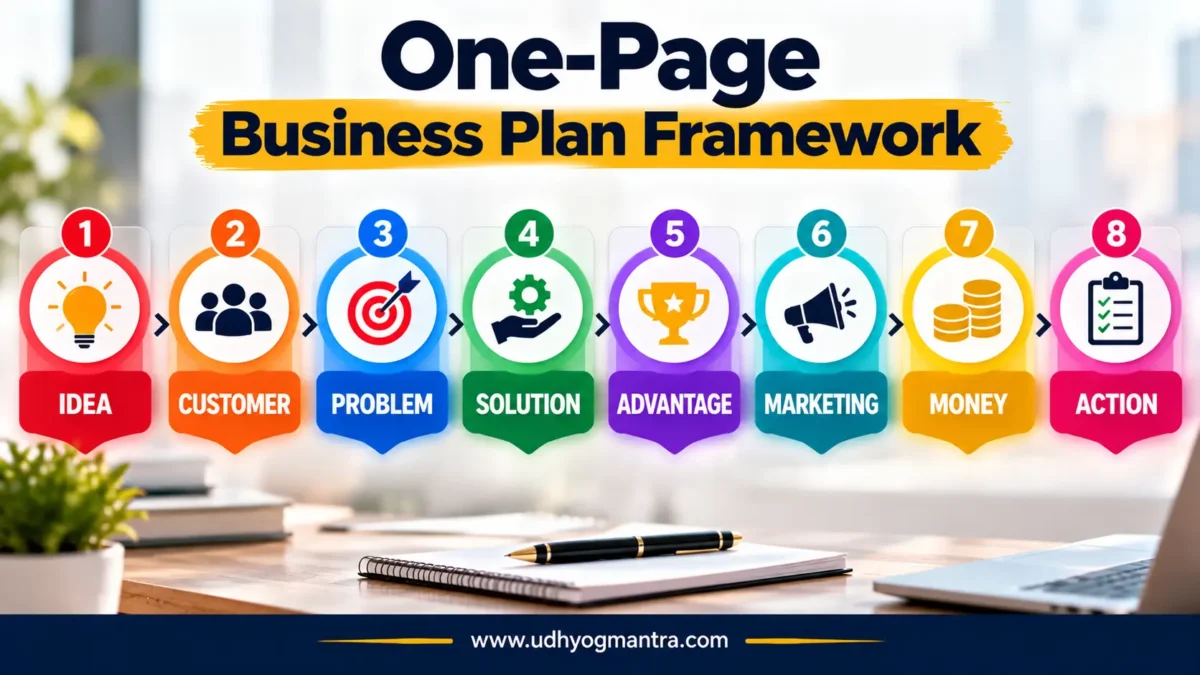
Follow this process:
- Define what your business does.
- Identify your ideal customer.
- Explain the problem you’re solving.
- Describe your product or service.
- Establish your competitive advantage.
- Choose how you’ll attract customers.
- Calculate basic costs and revenue.
- Set measurable goals for the next 90 days.
Use short sentences, specific numbers, and realistic assumptions.
Your finished plan should help you answer:
What should I do next—and why?
The One-Page Business Plan at a Glance
| Section | Key Question |
|---|---|
| Business concept | What are you building? |
| Customer | Who will buy? |
| Problem | What needs fixing? |
| Solution | What will you sell? |
| Advantage | Why choose you? |
| Marketing | How will buyers find you? |
| Financials | Can the business make money? |
| Action plan | What happens in the next 90 days? |
You don’t need to complete every section perfectly on your first attempt.
You do need to be specific enough that the plan can be tested.
Why a One-Page Business Plan Works for Small Businesses
The biggest advantage isn’t that it’s short.
It’s that the format forces you to make decisions.
A traditional plan can sometimes hide uncertainty behind detailed explanations.
A one-page plan has less room for that.
Consider these two statements:
Vague: We aim to become a leading provider of innovative marketing solutions.
Specific: We help independent dental practices generate appointment requests through local SEO and Google Ads, charging a $1,200 monthly service fee.
The second statement tells you much more.
You know the customer, service, acquisition focus, and revenue model.
That’s the discipline a useful one-page business plan creates.
Five Practical Benefits
Clarity: You can see the business model without searching through dozens of pages.
Speed: You can prepare an initial draft without weeks of planning.
Flexibility: Updating a single page is easier than rewriting a long document.
Focus: The format makes you prioritize the decisions that matter most.
Accountability: Clear goals and deadlines make it easier to measure progress.
But there is an important limitation.
A one-page plan is not a substitute for detailed financial modeling, regulatory analysis, or the documentation a lender or investor may require.
It’s a practical starting point—not a universal replacement for deeper planning.
Step 1: Write Your Business Concept in One Sentence
Start with a sentence that explains what the business does, who it serves, and what value it provides.
Use this formula:
We help [specific customer] achieve [specific outcome] through [product or service].
For example:
“We help independent restaurants reduce food waste through weekly inventory analysis and ordering recommendations.”
Or:
“We provide mobile car detailing for busy professionals who want their vehicles cleaned at home or work.”
Avoid words that sound impressive but don’t communicate anything.
Words like innovative, disruptive, and world-class rarely explain why a customer should pay you.
Your business concept should be understandable to someone outside your industry.
If it requires five minutes of explanation, simplify it.
Step 2: Identify Your Ideal Customer
A business can’t serve everyone equally well.
At least, not when it’s just starting.
Imagine opening a fitness studio and defining your audience as:
“People who want to get fit.”
That’s nearly everybody.
Now compare it with:
“Working professionals aged 30–50 in suburban Austin who want instructor-led strength training before 8 a.m.”
The second description is more useful because it influences location, operating hours, pricing, advertising, and class design.
What Should Your Customer Profile Include?
For consumer businesses, consider:
- Geographic location.
- Relevant age or life-stage characteristics.
- Purchasing habits.
- Needs and frustrations.
- Budget.
- Buying triggers.
For B2B businesses, consider:
- Industry.
- Company size.
- Decision-maker.
- Operational challenges.
- Budget ownership.
- Purchasing process.
Don’t invent an ideal customer simply because the description sounds attractive.
Research real buyers.
If you’re still unsure whether people want your offer, read our guide on how to validate a business idea before you spend real money before investing heavily in the business.
Step 3: Define the Problem You’re Solving
Customers rarely buy products just because the founder thinks they’re interesting.
They buy because something helps them achieve a goal, reduce a frustration, save time, avoid a risk, or improve an experience.
Your plan should identify that underlying problem.
Consider a local bookkeeping business.
Weak problem statement:
“Small businesses need bookkeeping.”
Better:
“Independent contractors struggle to maintain accurate monthly records and often scramble to organize transactions before tax season.”
The second version provides a clearer foundation for an offer.
Three Questions That Reveal a Real Problem
Ask yourself:
- When does the customer experience this problem?
- What are they currently doing about it?
- What happens if the problem remains unresolved?
The third question is especially revealing.
A problem that’s mildly annoying may be difficult to monetize.
A problem that repeatedly costs someone money, time, or customers may create a stronger commercial opportunity.
Still, don’t assume that every painful problem represents a profitable market.
You need evidence of demand and willingness to pay.
Step 4: Explain Your Product or Service
Now describe what customers will actually purchase.
Not your vision for the next decade.
Your first meaningful offer.
For a service business, identify the deliverables.
For a product business, explain the product and its primary benefit.
For a subscription business, clarify what customers receive and how often.
Example: Mobile Car Detailing
Service: Interior and exterior mobile car detailing.
Target customer: Busy professionals in a defined local service area.
Core benefit: Professional detailing without visiting a shop.
Initial price: $149 per appointment.
Delivery: At the customer’s home or workplace.
This is a hypothetical offer, not a verified market price.
The founder would still need to research competitors, test customer demand, and calculate the actual cost of delivering the service.
That distinction matters.
A plan should clearly separate known facts from assumptions.
Step 5: Define Your Competitive Advantage
Every business competes against something.
Sometimes it’s another company.
Sometimes it’s a freelancer, an in-house employee, a spreadsheet, or the customer’s decision to do nothing.
Your plan should explain why someone would choose your offer over those alternatives.
Common competitive advantages include:
- Greater convenience.
- Specialized expertise.
- Faster turnaround.
- Better customer service.
- Stronger accessibility.
- More predictable pricing.
- Better quality for a defined audience.
- A distinctive customer experience.
Avoid writing:
“We offer the best quality at affordable prices.”
Almost every business says that.
Instead, make the difference measurable or observable.
For example:
“We offer scheduled mobile detailing at customers’ workplaces, eliminating the need to visit a detailing shop.”
That’s a specific benefit.
Whether customers value it enough to pay is something you still need to test.
Step 6: Choose Your Customer Acquisition Strategy
A business plan without a customer acquisition strategy is mostly wishful thinking.
You may have a good product.
But how will customers discover it?
For a small business, focus on two or three realistic channels instead of listing every marketing platform available.
Examples by Business Type
| Business | Potential Acquisition Channels |
|---|---|
| Local home services | Google Business Profile, referrals, local search |
| B2B consulting | LinkedIn outreach, referrals, partnerships |
| Ecommerce | Organic search, paid search, email |
| Freelance services | Portfolio, direct outreach, referrals |
| Local fitness studio | Local search, partnerships, community outreach |
These are options to test, not guaranteed winning channels.
Choose based on where your actual customers research and buy.
Add a Measurable Target
Weak:
“Grow through social media.”
Better:
“Contact 40 qualified prospects per month and book eight discovery calls.”
The second statement gives you something to measure.
If the calls aren’t happening, you can investigate whether the problem is targeting, messaging, outreach quality, or offer relevance.
Without a measurable target, the plan can’t tell you whether you’re making progress.
Step 7: Calculate Your Basic Business Economics

This is where a one-page business plan becomes much more valuable.
A business can attract customers and still lose money.
Your plan should include at least four numbers:
Selling price.
Variable cost per sale.
Monthly fixed costs.
Expected sales volume.
Let’s use a hypothetical mobile detailing business.
| Financial Item | Illustrative Amount |
|---|---|
| Price per appointment | $149 |
| Variable cost per appointment | $39 |
| Contribution per appointment | $110 |
| Monthly fixed costs | $2,200 |
| Break-even appointments | 20 |
The calculation:
$149 − $39 = $110 contribution per appointment.
Then:
$2,200 ÷ $110 = 20 appointments.
At 20 appointments, the business covers the fixed costs assumed in this simplified example.
At 30 appointments:
Revenue = 30 × $149 = $4,470
Variable costs = 30 × $39 = $1,170
Contribution = $3,300
After $2,200 of fixed costs:
Illustrative operating surplus = $1,100.
That is not necessarily take-home pay or net profit after all expenses and taxes.
The calculation excludes anything not included in the stated cost assumptions, and the founder must check whether owner labor, travel, insurance, equipment replacement, financing costs, taxes, and other relevant expenses have been accounted for.
Why These Numbers Matter
Suppose your plan requires 20 appointments per month to cover costs.
That’s approximately five appointments per week in a four-week planning month.
Now you have a concrete operating question:
Can you reliably generate and deliver that volume?
If the answer is uncertain, you know exactly what to investigate before expanding.
Step 8: Build a 90-Day Action Plan
Most business plans describe where the founder wants to go.
Fewer explain what happens next Monday.
That’s a problem.
Your one-page plan should translate strategy into actions with dates, responsibilities, and measurable outcomes.
Days 1–30: Validate
Focus on understanding the market and testing assumptions.
Possible tasks:
- Interview prospective customers.
- Research competitors.
- Confirm the initial offer.
- Test pricing.
- Estimate costs.
- Check licensing and insurance requirements.
Milestone: Enough evidence to justify a limited launch.
Days 31–60: Launch Small
Focus on delivering the offer to real customers.
Possible tasks:
- Complete necessary setup.
- Launch a basic website or booking process.
- Start customer outreach.
- Deliver initial orders or services.
- Track costs and customer feedback.
Milestone: Initial paying customers and operational data.
Days 61–90: Improve
Focus on identifying what works.
Possible tasks:
- Review acquisition channels.
- Calculate contribution per sale.
- Analyze customer feedback.
- Adjust pricing if evidence supports it.
- Improve delivery efficiency.
- Set the next quarterly target.
Milestone: A decision about what to continue, change, or stop.
This 90-day framework is an editorial planning tool, not a guarantee that every business can launch within 90 days.
Some businesses require substantially longer preparation.
A Complete One-Page Business Plan Example
Let’s put everything together.
The following example is entirely hypothetical. It demonstrates how a U.S. small-business owner could summarize an early-stage business on one page.
Example: ClearRide Mobile Detailing — Austin, Texas
| Section | One-Page Plan |
|---|---|
| Business | ClearRide Mobile Detailing provides car detailing at customers’ homes and workplaces in a defined Austin service area. |
| Customer | Busy professionals who value convenience and are willing to pay for mobile service. |
| Problem | Customers want clean vehicles but dislike traveling to a detailing shop and waiting for service. |
| Solution | Scheduled mobile interior and exterior detailing at an initial test price of $149. |
| Advantage | Convenient on-site appointments and a straightforward booking process. |
| Marketing | Local search, referrals, and targeted outreach to nearby workplaces. |
| Financials | $149 price; $39 estimated variable cost; $2,200 estimated monthly fixed costs; 20 appointments to break even under stated assumptions. |
| 90-Day Goal | Validate demand, complete required setup, secure initial customers, and test whether appointment volume and delivery costs support the model. |
This is the level of clarity you should aim for.
The entire business concept can be understood in under two minutes.
And more importantly, it raises useful questions.
Are customers willing to pay $149?
Can the business consistently deliver services at the estimated variable cost?
How many bookings can the owner realistically complete?
Which marketing channel generates customers at an acceptable cost?
These are questions the founder can now test.
That’s what makes the plan useful.
Free One-Page Business Plan Template: Copy and Fill In
Use the following template for your own business.
Business Overview
Business name: [Your business name]
Location/market: [City, state, or geographic coverage]
Business concept: We help [customer] achieve [outcome] through [product/service].
Customer and Problem
Ideal customer: [Specific customer group]
Main problem: [Problem they experience]
Current alternatives: [How they solve it today]
Product and Advantage
Core offer: [What customers buy]
Price: [$ amount]
Why customers choose us: [Specific advantage]
Marketing and Sales
Primary acquisition channel: [Channel]
Secondary channel: [Channel]
Monthly lead target: [Number]
Monthly sales target: [Number]
Financial Plan
Price per sale: [$]
Variable cost per sale: [$]
Monthly fixed costs: [$]
Contribution per sale: [$]
Break-even sales volume: [Number]
Next 90 Days
First 30 days: [Priority]
Days 31–60: [Priority]
Days 61–90: [Priority]
Most important success metric: [Metric]
Biggest unresolved assumption: [Assumption]
Next decision date: [Date]
Keep the final version to one page by using concise answers.
If you need detailed supporting calculations, store them in a separate spreadsheet rather than shrinking the document to unreadable text.
The One-Page, Three-Decisions Framework
Here’s a practical way to evaluate whether your plan is actually useful.
Every section should support one of three decisions.

Decision 1: What Are We Selling—and to Whom?
This includes your customer, problem, offer, and competitive advantage.
If these are unclear, you have a positioning problem.
Decision 2: How Will the Business Make Money?
This includes pricing, acquisition, delivery costs, and break-even economics.
If these are unclear, you have a business-model problem.
Decision 3: What Will We Do Next?
This includes the next 90 days, measurable milestones, and the biggest remaining assumptions.
If these are unclear, you have an execution problem.
A one-page business plan should help you identify which of these three problems needs attention.
Otherwise, it’s just a nicely formatted description of an idea.
One-Page Business Plan vs. Traditional Business Plan
A one-page plan and a traditional business plan serve different purposes.
| Factor | One-Page Plan | Traditional Plan |
|---|---|---|
| Length | One page | Often multiple pages |
| Detail | High-level | More comprehensive |
| Preparation | Relatively quick | Usually more involved |
| Financials | Summary | Detailed projections |
| Best use | Early planning and ongoing decisions | Financing, complex planning, detailed stakeholder review |
| Updates | Easy to revise | May require more extensive changes |
The SBA explains that traditional business plans are commonly requested by lenders and investors, while lean plans focus on essential information and may need additional detail for some financing situations.
Source: SBA Business Planning Guidance
When Is a One-Page Plan Not Enough?
Consider a more detailed plan when:
- Applying for financing that requires financial projections.
- Seeking significant outside investment.
- Planning a capital-intensive operation.
- Entering a heavily regulated industry.
- Managing multiple business units.
- Preparing a complex expansion.
- Evaluating significant long-term commitments.
A one-page plan can still serve as the executive summary of a more detailed planning package.
How Often Should You Update Your One-Page Business Plan?
A business plan should change when the evidence changes.
For an early-stage business, a monthly review can be useful.
Ask:
- Did we reach our customer acquisition target?
- Did customers buy at the expected price?
- Were actual costs higher than planned?
- Which assumptions proved incorrect?
- What changed in the competitive environment?
- What is the most important decision for next month?
A Simple 30/60/90-Day Review System
Every 30 days: Review actual performance against your targets.
Every 60 days: Reassess pricing, acquisition channels, and operational constraints.
Every 90 days: Decide whether to maintain, revise, expand, or stop specific activities.
These intervals are suggested management practices, not official regulatory requirements.
The important habit is reviewing your assumptions against real business results.
Seven Common One-Page Business Plan Mistakes
1. Writing a Mission Statement Instead of a Business Model
“We empower communities through excellence” doesn’t explain what you sell.
Start with the actual business.
2. Defining Everyone as Your Customer
A vague audience makes marketing, pricing, and product decisions harder.
Identify your most relevant customer segment.
3. Ignoring Competitors
Even a new idea competes with existing alternatives.
Understand what customers currently use.
4. Inventing Financial Projections
A spreadsheet can calculate anything.
That doesn’t make the assumptions realistic.
Label estimates clearly and replace them with observed data as soon as possible.
5. Listing Too Many Marketing Channels
A small business rarely has the resources to execute ten acquisition strategies well.
Start with the channels most likely to reach qualified customers.
6. Setting Goals Without Deadlines
“Increase revenue” isn’t an actionable milestone.
“Secure ten paying customers by the end of the quarter” is more measurable.
7. Never Looking at the Plan Again
A business plan that sits untouched in a folder is unlikely to improve your decisions.
Review it.
Challenge it.
Update it.
Can You Start a Business With Only a One-Page Plan?
Yes, for some relatively simple businesses, a one-page plan may provide a useful initial strategy.
But the plan itself doesn’t satisfy legal, tax, licensing, insurance, financing, or other operational requirements.
For example, a freelance consultant and a food manufacturer face very different compliance and operational needs.
A concise plan can organize the decisions.
It cannot replace the work required to launch legally and responsibly.
If you’re moving from planning into execution, our 12-step guide to starting a small business in the U.S. explains the broader process, from validation and registration to banking, funding, and launch.
Final Checklist: Is Your One-Page Business Plan Ready?
Before calling the plan finished, check whether you can answer the following questions.
- Can someone understand the business in one sentence?
- Have you identified a specific customer?
- Is the customer problem clearly defined?
- Have you described what customers will buy?
- Do you understand the main alternatives?
- Is your competitive advantage specific?
- Have you selected realistic acquisition channels?
- Have you estimated the selling price and delivery costs?
- Do you know your approximate break-even volume?
- Are your assumptions clearly distinguished from facts?
- Have you defined measurable 90-day priorities?
- Have you set a date to review the plan?
If you can answer these questions, you have something more valuable than a polished document.
You have a starting point for making decisions.
Final Takeaway: A Business Plan Should Help You Run the Business
A one-page business plan isn’t supposed to predict the future.
It’s supposed to help you prepare for it.
You don’t need a complicated document to explain a simple business.
You need clarity about your customers, your offer, your economics, and your next actions.
Start with one page.
Test your assumptions.
Replace guesses with evidence.
Update the plan when reality gives you new information.
And remember:
The best business plan isn’t the one that looks impressive on paper. It’s the one you actually use to make better decisions.
Frequently Asked Questions
A one-page business plan should typically include the business concept, target customer, customer problem, product or service, competitive advantage, customer acquisition strategy, basic financials, and near-term action plan. The exact sections can vary by business type and intended audience.
Yes. A one-page plan summarizes the most important business decisions rather than documenting every detail. The SBA recognizes lean startup business plans that can be as short as one page. More complex businesses or financing applications may require additional documentation.
An initial draft may take about an hour if you already understand your customers, offer, and costs. The SBA notes that lean plans can take as little as one hour to prepare. Researching and validating the assumptions may take considerably longer.
Not necessarily. Lenders may request detailed financial projections, supporting documents, business history, funding requirements, and other information. Check the lender’s specific requirements before applying.
Include at least a basic financial summary covering pricing, expected sales, variable costs, fixed costs, and break-even volume. Detailed cash-flow forecasts and financing models can be maintained separately when needed.
A lean business plan is a streamlined planning approach focused on the most important elements of a business. A one-page business plan describes the document’s length. Many lean plans fit on one page, but the terms aren’t identical.
AI can help organize ideas, improve wording, create outlines, and identify missing questions. However, it cannot independently verify your actual customer demand, pricing, expenses, or ability to deliver. Check all generated claims and calculations against reliable information.


