

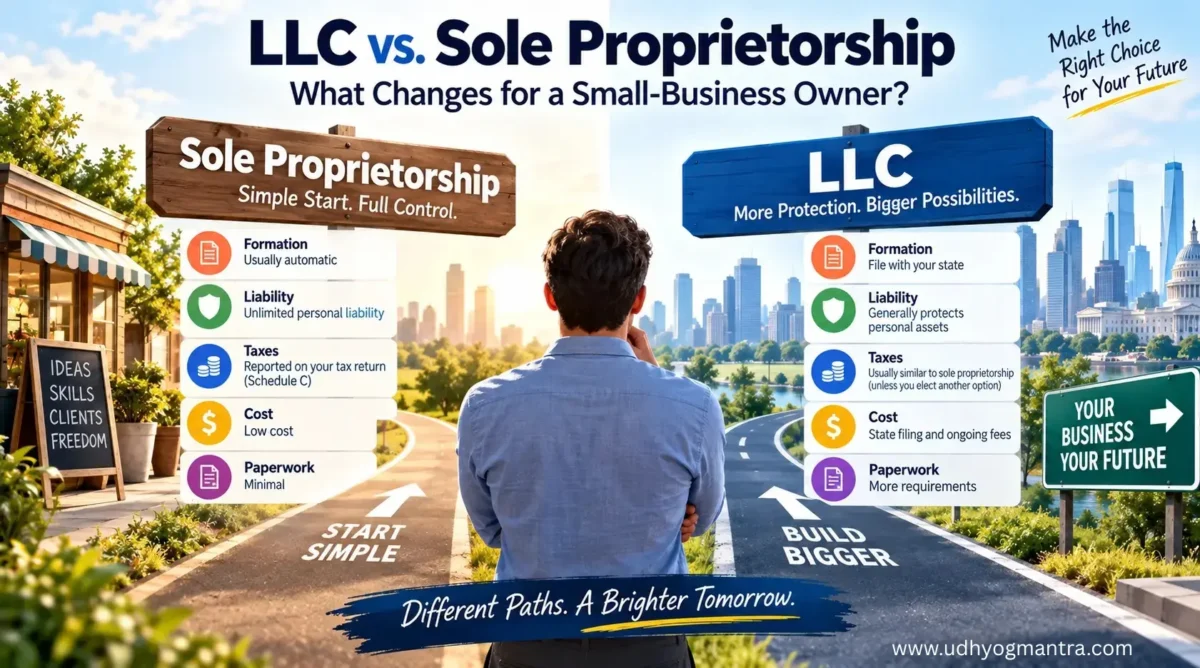
Choosing between an LLC vs. sole proprietorship isn’t just about putting different letters after your business name. The choice can affect personal liability, formation requirements, ongoing paperwork, taxes, banking, and how you prepare the business for future growth.
For many solo U.S. business owners, the distinction starts with one fundamental difference: a sole proprietorship does not create a separate legal business entity, while an LLC is created under state law and generally separates the business entity from its owner.
But here’s where people get confused:
Forming an LLC does not automatically mean your federal income taxes completely change.
A single-member LLC can still be treated by the IRS as a disregarded entity for federal income-tax purposes unless it elects another tax classification.
So the real question isn’t simply:
“Is an LLC better?”
It’s:
“What actually changes if I move from operating as a sole proprietor to operating through an LLC—and do those changes matter for my business?”
That’s what this guide will answer.
LLC vs. Sole Proprietorship—What’s the Difference?
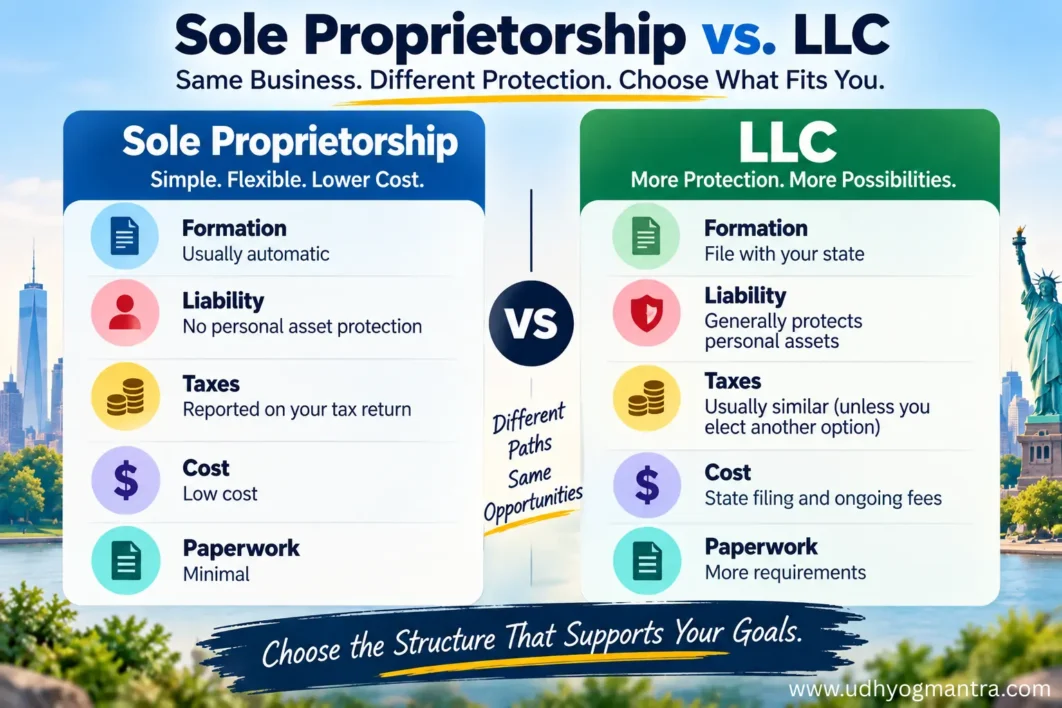
A sole proprietorship is an unincorporated business owned by one individual and does not create a separate legal entity from its owner. An LLC, or limited liability company, is an entity created under state law that generally provides separation between the owner’s personal assets and the business’s liabilities. However, a single-member LLC is usually treated like a sole proprietorship for federal income tax purposes unless another tax classification is elected.
Here’s the comparison at a glance:
| Factor | Sole Proprietorship | Single-Member LLC |
|---|---|---|
| Separate state-law entity | No | Yes |
| Formation | Usually exists automatically when an individual conducts business without forming another entity | Formed under state law |
| Personal liability | The owner can be personally responsible for business debts and obligations. | Generally provides liability separation, subject to applicable law and circumstances |
| Federal income tax default | Reported by owner, generally using Schedule C for a typical trade or business | Usually disregarded; income is generally reported by the owner unless another classification is elected |
| State filing requirements | Usually fewer entity-formation requirements | Formation and ongoing requirements vary by state. |
| Cost | Generally lower | State filing and possibly recurring state costs |
| Administration | Simpler | More formal separation and recordkeeping are advisable |
| Suitable for | Often low-risk or early-stage activities | Often considered when liability exposure or need for legal separation increases |
The SBA specifically notes that sole proprietorships can suit low-risk businesses and owners testing an idea, while LLCs can be appropriate for businesses where owners want greater separation between personal and business liabilities.
But don’t decide on this table alone.
The details matter.
First, Understand What a Sole Proprietorship Actually Is
A sole proprietorship is the simplest way many one-person businesses begin operating.
The IRS defines a sole proprietorship as an unincorporated business owned by one individual. The business has no separate legal identity from its owner, and the owner is personally responsible for its debts.
The SBA puts it in practical terms: if you conduct business activities but don’t register as another type of business entity, you’re generally considered a sole proprietor.
Imagine Maya begins offering freelance graphic design services.
She gets a client.
The client pays her $1,500.
Maya hasn’t formed an LLC or corporation.
She may already be conducting business as a sole proprietor.
There wasn’t necessarily a dramatic moment involving a conference room, three attorneys, and a ceremonial ribbon-cutting.
The business started when the business activity started.
That’s part of the attraction.
Why Do People Start as Sole Proprietors?
For a solo business owner, the advantages include simplicity, minimal entity-level formation paperwork, direct control, and a lower initial administrative burden.
That can make the structure practical for someone testing a relatively low-risk idea.
Think:
- freelance writer
- independent designer
- solo consultant
- photographer
- small service provider
- creator earning business income
But simplicity has a trade-off.
The business and owner aren’t legally separated in the way they generally are with an LLC.
And that brings us to the biggest difference.
What Is an LLC?
An LLC—limited liability company—is a business entity created under state law.
The IRS notes that LLC rules can differ from state to state and that LLC owners are called members. Most states permit single-member LLCs, meaning an LLC can have just one owner.
An LLC creates a legal structure around the business.
That matters because the business entity can generally hold assets and liabilities separately from the owner’s personal assets and liabilities.
But don’t confuse legal structure with tax classification.
They are related, but they aren’t identical.
This distinction is one of the most important things in this entire article.
Difference #1: Personal Liability
This is usually the biggest reason a small-business owner starts comparing a sole proprietorship vs. LLC.
With a sole proprietorship, there isn’t a separate legal entity between the owner and the business.
The SBA states that the owner’s business assets and liabilities aren’t separate from personal assets and liabilities and that the owner can be personally liable for business debts and obligations.
An LLC generally creates legal separation.
That doesn’t mean the words “LLC” create an invisible force field around everything you own.
Liability protection can depend on state law, the facts of a dispute, personal guarantees, the owner’s conduct, whether business and personal affairs were properly separated, and other circumstances.
But structurally, there is an important distinction:
Sole proprietorship: You and the business aren’t separate legal entities.
LLC: The business is organized as a separate state-law entity.
Think About Liability as Exposure, Not Fear (H3)
Suppose two people run separate businesses.
Business A: A freelance copywriter working remotely with three established corporate clients.
Business B: A home-services contractor whose employees regularly enter customer properties and use equipment.
Those businesses don’t have identical risk profiles.
The question shouldn’t be:
“Are LLCs good?”
It should be:
“What could realistically go wrong in this business, and what would happen to me personally if it did?”
That’s a much better decision question.
Difference #2: Federal Taxes Are More Similar Than Many People Think
This is where online explanations frequently become unnecessarily confusing.
A sole proprietor generally reports business income and expenses on the owner’s federal tax return—typically using Schedule C for an ordinary trade or business.
Now suppose the same person creates a single-member LLC.
Did the federal income tax treatment automatically become completely different?
Usually, no.
By default, the IRS generally treats a domestic single-member LLC as a disregarded entity for federal income-tax purposes unless it elects to be treated as a corporation. Its business activity is therefore generally reported on the owner’s federal return.
In other words:
Legal structure and federal tax classification aren’t the same question.
That’s why saying
“I formed an LLC, so now I’m taxed like a corporation.”
can be incorrect.
What About Self-Employment Tax?
An individual owner of a single-member LLC treated as a disregarded entity generally remains subject to self-employment tax on net earnings from the business in the same manner as a sole proprietor.
An LLC can potentially elect another federal tax classification if eligible and appropriate, but that’s a separate decision with tax consequences.
Don’t make that election because a 34-second video promised you discovered a secret tax hack.
This is an area where a qualified tax professional can be worth considerably more than their invoice.
Difference #3: Formation and Cost
A sole proprietorship generally doesn’t require you to create a separate state-law entity.
That doesn’t mean zero paperwork.
Depending on where and what you operate, you might still need:
- a DBA or fictitious business name
- business licenses
- professional licenses
- permits
- state or local tax registration
- sales tax registration
- other industry-specific approvals
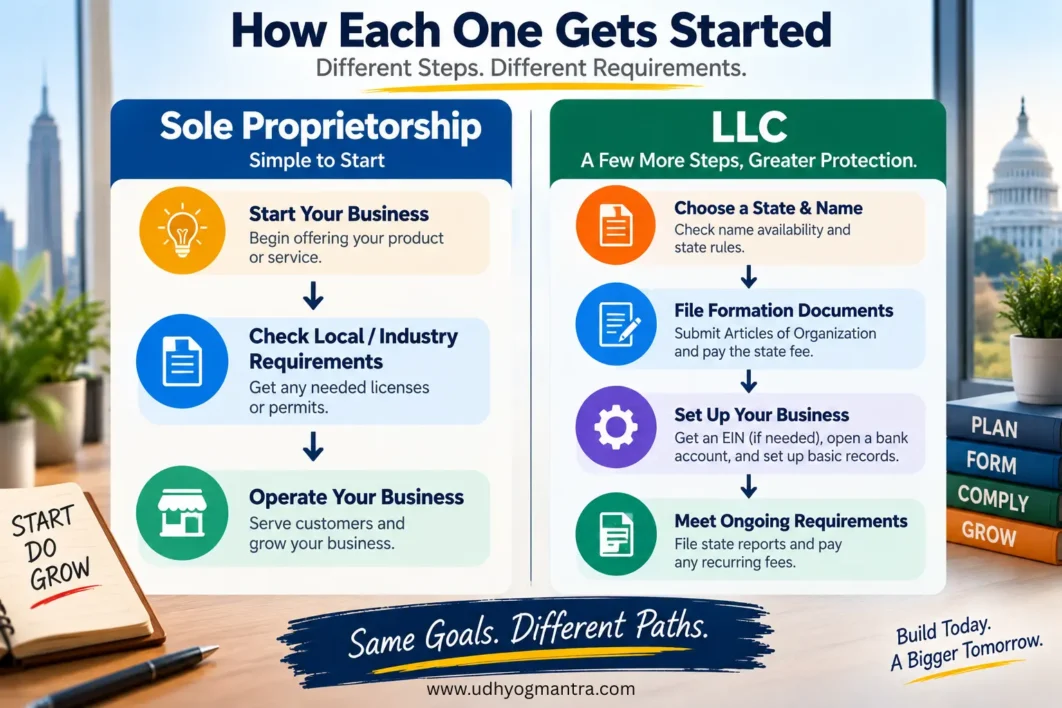
An LLC requires state-level formation.
The precise filing, terminology, fees, publication rules, reports, franchise taxes, and other requirements vary by state.
That last sentence matters.
There is no responsible nationwide answer to:
“How much does an LLC cost?”
without specifying the state and potentially the business circumstances.
A California business and a Wyoming business shouldn’t assume they have identical requirements because they both found the same blog post.
Difference #4: Paperwork and Business Separation
Sole proprietorships are attractive partly because of their simplicity.
An LLC adds another layer.
Depending on the state and circumstances, that may include formation documents, state reports, registered-agent requirements, fees, and other compliance obligations.
But administrative discipline isn’t just government paperwork.
Once you create an LLC, it becomes particularly important to behave like you’re operating a separate business.
That means taking business separation seriously:
- separate business banking
- clean bookkeeping
- properly documented business transactions
- contracts in the appropriate business name
- organized records
- compliance with applicable state requirements
The letters LLC shouldn’t be treated as a substitute for actually running the entity properly.
If you’re still at the earlier stage of establishing the company itself, our [guide to starting a small business in the U.S.] walks through validation, registration, tax IDs, banking, funding, and launch in sequence.
INTERNAL LINK #1
Anchor text: guide to starting a small business in the U.S.
Target: How to Start a Small Business in the U.S.: A Practical 12-Step Guide
Difference #5: Getting an EIN
Another common misconception is:
“Every LLC must have an EIN, while a sole proprietor never needs one.”
Reality is more nuanced.
The IRS says a single-member LLC treated as a disregarded entity that has no employees and no applicable excise-tax liability generally doesn’t need a separate EIN for federal tax purposes.
However, the business may obtain an EIN for reasons such as banking or state requirements. An LLC also needs an EIN in various other circumstances, including when it has employees.
A sole proprietor may also need an EIN depending on circumstances.
So once again:
LLC ≠ automatic universal EIN rule.
Check your actual situation against current IRS guidance.
Difference #6: Raising Money and Growing the Business
Your entity choice can also influence what happens when the business becomes more complicated.
A sole proprietorship works naturally around one owner.
But what happens when you want to:
- add another owner
- bring in investors
- transfer ownership interests
- create a more formal governance structure
- significantly increase borrowing
- build a company designed to operate beyond one individual
At that point, structure becomes more important.
The SBA notes that business structure can affect fundraising as well as taxes, paperwork, and personal liability.
That doesn’t mean every ambitious business should automatically choose an LLC.
A high-growth startup seeking venture capital, for example, may evaluate a corporation instead.
The point is simpler:
Choose based partly on where the business is going—not only where it is today.
Difference #7: Credibility Is Useful, but Don’t Overrate Three Letters
Some owners prefer operating through an LLC because it creates a more formal business identity.
Customers, vendors, landlords, lenders, or partners may also expect a formal entity in certain circumstances.
But an LLC doesn’t magically make a business credible.
A customer still cares whether you:
- answer the phone
- deliver what you promised
- meet deadlines
- solve the problem
- handle complaints properly
- send accurate invoices
- act professionally
“Acme Strategy LLC” can still provide terrible strategy.
And “Jane Smith, freelance consultant” can run an outstanding six-figure operation.
Structure matters.
Execution matters more.
Case Study: A $12,000 Ice-Cream Shop Shows Why Structure Needs Can Change
Ben Cohen and Jerry Greenfield opened their first Ben & Jerry’s ice-cream shop in a renovated Burlington, Vermont, gas station in 1978.
According to Ben & Jerry’s official history, they started with a $12,000 investment, including $4,000 that was borrowed.
The business didn’t remain one little scoop shop.
By 1980, they were packing ice cream into pints and distributing it to grocery and mom-and-pop stores. In 1981, the first franchised scoop shop opened.
Decades later, Ben & Jerry’s was operating as a corporation and ultimately became a wholly owned subsidiary following its 2000 acquisition.
What Does That Have to Do With LLC vs. Sole Proprietorship?
The lesson isn’t that Ben & Jerry’s proves one entity is superior.
It doesn’t.
The lesson is that business structure should reflect business reality.
A tiny owner-operated operation has different ownership, liability, financing, governance, and expansion needs from a business manufacturing products, entering wholesale distribution, franchising locations, hiring employees, and operating at scale.
Your structure doesn’t need to anticipate every possible version of your company 20 years from now.
But it shouldn’t ignore the next realistic stage either.
Ask:
“What does this business need today—and what is reasonably likely to change over the next few years?”
That’s a better question than choosing an entity because a famous founder chose one.
LLC vs. Sole Proprietorship: A Practical Decision Framework
Instead of asking which structure is universally “better,” evaluate five factors.

1. Risk
What could expose the business to meaningful claims, debts, accidents, contractual disputes, property damage, or other liabilities?
The higher the exposure, the more seriously liability separation deserves consideration.
2. Money
What will formation and ongoing compliance cost in your state?
Don’t compare a $0 theoretical sole proprietorship against a generic national LLC price.
Calculate the actual costs where you operate.
3. Tax
How will the business be classified for federal and state tax purposes?
Remember: forming a single-member LLC does not automatically mean the business is taxed as a corporation.
4. Complexity
How much administrative work does the business owner realistically want and need?
Formal structure can provide benefits, but it also creates responsibilities.
5. Future
Will you remain a one-person operation?
Could you add owners?
Hire employees?
Seek financing?
Take on larger contracts?
Expand into other states?
Sell the business?
Your likely next stage should influence the decision.
When Might a Sole Proprietorship Make Sense?
A sole proprietorship may be worth considering when you’re one owner, the activity is relatively low risk, you’re testing a business concept, you want minimal entity-level complexity, and the costs of creating another entity don’t yet appear justified.
The SBA itself notes that a sole proprietorship can be appropriate for low-risk businesses and owners who want to test an idea before establishing a more formal structure.
The words “test an idea” are important.
Before spending money creating an elaborate business infrastructure, it can make sense to determine whether anyone wants the product in the first place.
Our guide on how to validate a business idea before you spend real money explains how to test demand using customer behavior rather than compliments.
When Might an LLC Make Sense?
An LLC may deserve stronger consideration when the business has meaningful liability exposure, the owner wants a legally distinct business entity, contracts or assets are becoming more significant, multiple parties may eventually be involved, or the business has moved beyond a casual experiment.
The SBA describes LLCs as a potential choice for medium- or higher-risk businesses and owners seeking protection for significant personal assets.
That still isn’t a universal recommendation.
State rules vary.
Tax situations vary.
Business risks vary.
And an LLC doesn’t replace:
- insurance
- good contracts
- proper bookkeeping
- tax compliance
- licensing
- professional advice
- basic common sense
It’s a legal structure—not a superhero cape.
Can You Start as a Sole Proprietor and Form an LLC Later?
Yes, many businesses begin simply and later adopt a formal entity structure.
But changing structures isn’t always as simple as clicking “upgrade.”
Depending on the business and state, you may need to deal with registrations, tax IDs, banking, licenses, contracts, assets, insurance, accounting, or tax consequences.
The SBA specifically warns that converting business structures later can involve location-specific restrictions, tax consequences, or other complications.
So “I’ll fix it later” isn’t a strategy.
Neither is “I need the most complicated structure immediately.”
Choose based on the business you actually have and the reasonably foreseeable risks ahead.
Does an LLC Pay Less Tax Than a Sole Proprietorship?
Not automatically.
This deserves its own section because the misconception is everywhere.
A single-member LLC that accepts its default federal income-tax classification is generally disregarded as separate from its owner. An individual owner generally reports the activity on the owner’s return, much as a sole proprietor does.
An LLC may be able to elect different federal tax treatment, depending on eligibility and circumstances.
But:
LLC is a legal entity type.
S corporation is a federal tax status/election.
They aren’t interchangeable terms.
Before changing tax treatment, calculate the actual tax and administrative consequences with an appropriate tax professional rather than optimizing for a social media soundbite.
Common LLC vs. Sole Proprietorship Mistakes
Mistake #1: Assuming an LLC Automatically Cuts Your Taxes
It doesn’t.
Default federal tax treatment for a single-member LLC can be very similar to that of a sole proprietor.
Mistake #2: Forming an LLC and Ignoring Business Separation
Creating the entity is the beginning of the administrative work, not the end.
Keep business records and finances properly organized.
Mistake #3: Choosing Sole Proprietorship Only Because It’s Cheap
Low cost matters.
So does risk.
Saving formation expenses may be a poor trade if the business creates substantial liability exposure.
Mistake #4: Choosing an LLC Because It “Looks Professional”
Professionalism comes primarily from how the business operates.
Choose structure for substantive reasons.
Mistake #5: Copying Another Entrepreneur’s Structure
Their revenue, state, liability, ownership, tax situation, and plans may be completely different from yours.
Mistake #6: Ignoring State Rules
An article discussing U.S. business entities can explain general principles.
It cannot replace the rules of your particular state.
LLC vs. Sole Proprietorship Checklist
Before deciding, answer these questions:
- Am I the only owner?
- What could realistically create liability?
- Do customers enter my property?
- Do I enter customers’ property?
- Do I sell physical products?
- Do I employ or expect to employ people?
- Will I sign substantial contracts?
- Will the business borrow money?
- Do I have significant personal assets?
- What does an LLC cost in my state?
- What recurring state filings or fees apply?
- How will each option be taxed in my situation?
- Will I add another owner?
- Might I seek outside investment?
- Do licenses need to be transferred if the entity changes?
- Am I prepared to maintain separate business records?
If you can’t answer the cost, tax, and compliance questions yet, don’t guess.
Research them before filing.
And before you decide how much structure the company needs, it helps to know where the business itself is headed. A concise one-page business plan you will actually use can force those assumptions onto paper before they become expensive commitments.
Final Takeaway: LLC or Sole Proprietorship?
The biggest difference between an LLC vs. sole proprietorship is not prestige.
It’s legal separation.
A sole proprietorship is simple because the business and owner aren’t separate legal entities.
An LLC creates a state-law business entity that generally provides separation between the owner’s personal assets and the business’s liabilities.
Yet federal income-tax treatment can remain surprisingly similar when a single-member LLC uses its default disregarded-entity classification.
So don’t reduce the decision to
Sole proprietorship = beginner
and
LLC = serious business
That’s too simplistic.
Instead, evaluate:
Risk → Cost → Tax → Complexity → Future
A low-risk freelancer testing an idea and a contractor employing workers on customer properties aren’t facing the same decision.
Choose the structure that fits the business you’re actually building—not the one that looks best in an Instagram bio.
Frequently Asked Questions
Neither structure is universally better. A sole proprietorship generally offers greater simplicity, while an LLC creates a separate state-law entity and generally provides greater liability separation. The appropriate choice depends on risk, cost, state requirements, taxation, ownership, and plans.
Usually not when it retains its default disregarded-entity classification. An individual owner generally reports the LLC’s business activity on the owner’s federal return, such as Schedule C when applicable. Different rules apply if the LLC elects corporate tax treatment.
Not in every situation. The IRS says a disregarded single-member LLC with no employees and no applicable excise-tax obligations generally doesn’t need a separate EIN for federal tax purposes, although one may be obtained for banking or state requirements. Other circumstances can require one.
Yes. Operating as a sole proprietor does not itself prevent a business from hiring employees, although doing so introduces employer tax, payroll, insurance, labor-law, and other compliance responsibilities.
No. Entity-level liability protection and insurance address different risks. Appropriate insurance can remain important even when a business operates through an LLC.
Yes, but the process and consequences depend on the state and business circumstances. Registrations, banking, contracts, tax accounts, licenses, assets, and other records may need to be updated.
Disclaimer
This article provides general educational information about U.S. business structures. It is not individualized legal, tax, or accounting advice. Entity laws, filing requirements, fees, and tax consequences vary by state and individual circumstances. Readers making consequential entity or tax decisions should verify current requirements with the relevant government agency and, where appropriate, a qualified attorney or tax professional.