

Learning how to validate a business idea means replacing assumptions with evidence before you commit serious money, months of work, inventory, employees, software development, or an expensive launch.
Your idea may sound brilliant.
Your friends may love it.
Your spouse may say, “You should absolutely do this.”
And ChatGPT can probably produce a beautiful 20-page business plan for it before you’ve finished your coffee.
None of those things prove customers will pay.
Business idea validation is the process of testing whether a specific customer has a meaningful problem, whether your proposed solution interests them enough to act, whether they will pay, and whether you can deliver the solution with workable economics.
The goal isn’t to prove you’re right.
It’s to discover where you’re wrong while being wrong is still cheap.
Quick Answer: How Do You Validate a Business Idea?
To validate a business idea, define the customer and problem, identify the assumptions that must be true, research existing demand and competitors, interview real potential customers, test your proposed solution cheaply, ask for a meaningful commitment such as a booking, deposit, preorder, or paid pilot, and check whether the economics could support a sustainable business.
A practical validation sequence is:
- Define the customer.
- Define the problem.
- Identify your riskiest assumption.
- Research the market.
- Study competitors and alternatives.
- Interview potential customers.
- Create the smallest useful test.
- Test the offer and messaging.
- Test willingness to pay.
- Check basic economics.
- Evaluate the evidence.
- Decide: proceed, revise, pivot, or stop.
Notice what’s missing?
Logo design.
That’s intentional.
SUPPORTING IMAGE #1 — PLACE HERE
Concept: Simple Business Idea Validation Roadmap
Use only:
CUSTOMER → PROBLEM → DEMAND → TEST → PAYMENT → DECIDE
Large typography. Six clear icons. No explanatory paragraphs inside the graphic.
Filename: business-idea-validation-roadmap.webp
Alt text: Six-step roadmap for validating a business idea.
What Does It Mean to Validate a Business Idea?
Validation means gathering evidence that reduces uncertainty about the assumptions your business depends on.
Suppose you want to launch a monthly meal-prep service for busy accountants.
You are implicitly assuming:
- accountants have this problem
- the problem occurs frequently
- existing solutions aren’t good enough
- they care enough to change behavior
- your solution appeals to them
- your price is acceptable
- you can reach them
- you can deliver profitably
- enough customers will buy repeatedly
That’s not one assumption.
That’s a stack of assumptions wearing a business idea as a trench coat.
Validation pulls them apart and tests them.
Validation Does Not Mean Guaranteeing Success
No research process can prove a new business will succeed.
Customer behavior changes.
Competitors react.
Costs increase.
Execution matters.
Economic conditions change.
What validation can do is help you avoid committing large amounts of money to assumptions that could have been tested much more cheaply.
That’s an important distinction for AEO and for founders:
Validation reduces uncertainty. It does not eliminate business risk.
Why Validate Before You Spend Serious Money?
Because founders are unusually close to their own ideas.
You know why your idea should work.
You’ve probably replayed the best-case scenario dozens of times.
Customers haven’t.
That gap matters.
A February 2026 U.S. Census Bureau working paper examined administrative data linking 17 million business applications with subsequent outcomes. The researchers found that applicants, on average, overestimated employer entry, largely because many businesses expected to enter but did not.
That research isn’t evidence that your idea will fail.
It illustrates something more useful:
Expectations and outcomes aren’t the same thing.
Validation is an attempt to bring those two closer together before the expensive decisions begin.
Step 1: Define Exactly Who the Customer Is
Don’t begin with:
“My product is for everyone.”
That’s not a target market.
That’s the population of Earth.
Start narrower.
Instead of:
Small businesses
try:
Independent U.S. dental practices with 5–20 employees that struggle with appointment no-shows.
Instead of:
People who want to exercise
try:
Remote professionals in their 30s who want short strength workouts they can do at home before work.
The narrower definition makes validation easier because you know:
- whom to interview
- where to find them
- what alternatives to research
- which problems to investigate
- what language they use
- what price context matters
You can broaden later.
Early validation benefits from specificity.
Step 2: Define the Problem Without Mentioning Your Solution
Here’s a useful test.
Can you describe the customer problem without describing your product?
Weak:
“Small businesses need my AI scheduling platform.”
That’s a solution pretending to be a problem.
Better:
“Small service businesses lose staff time manually coordinating appointments across phone, email, and text.”
Now you have something you can investigate.
Ask:
- When does the problem happen?
- How frequently?
- Who experiences it?
- What does it cost?
- What happens if nobody fixes it?
- How are people solving it today?
A painful problem generally leaves evidence behind.
People complain about it.
Build workarounds.
Hire someone.
Buy software.
Use spreadsheets.
Waste time.
Lose money.
Or simply tolerate it because every alternative is worse.
Those behaviors are more interesting than someone saying your idea sounds cool.
Step 3: Find the Assumption Most Likely to Kill the Business
Every idea contains assumptions, but they aren’t equally dangerous.
Suppose you’re considering a premium dog-walking subscription.
Your assumptions might include:
- Busy dog owners need more reliable walking.
- They want a subscription rather than one-off bookings.
- They’ll pay $249 per month.
- You can recruit reliable walkers.
- Customer acquisition will be affordable.
- Scheduling can be managed efficiently.
Which assumption should you test first?
Not necessarily the easiest one.
Test the one that makes the business collapse if it’s false.
If customers will only pay $79 but your economics require $249, spending three months building scheduling software won’t rescue the model.
The UdhyogMantra “Kill Assumption” Rule
Write this sentence:
This business only works if __________ is true.
Fill in the blank.
Then ask:
What is the cheapest honest experiment that could prove this assumption wrong?
That is often where validation should begin.
This is our central framework for this guide:
Don’t test what is easiest to confirm. Test what would be most expensive to discover later.
Step 4: Research the Market Before You Ask Customers Anything
Customer interviews are important.
But first, understand the environment.
Research:
- market characteristics
- customer demographics
- purchasing behavior
- industry trends
- geographic concentration
- existing competitors
- substitutes
- pricing
- regulatory requirements
- potential market size
For U.S. businesses, government data can be especially useful.
Depending on the topic, relevant sources may include the U.S. Census Bureau, Bureau of Labor Statistics, Bureau of Economic Analysis, SBA, SEC, or specialized federal/state agencies.
But be careful with market-size theater.
“The market is worth $40 billion. If we capture only 1%…”
Stop.
One percent of a huge market can still be extremely difficult to acquire.
Market size tells you an opportunity may exist.
It doesn’t prove customers want your offer.
The SBA similarly recommends market research and competitive analysis to understand customers and find a competitive advantage.
Step 5: Study What Customers Already Use
Competition isn’t automatically bad news.
No competitors can mean:
“Untapped opportunity.”
It can also mean:
“Nobody cares enough to pay for this.”
Instead of simply counting competitors, investigate how customers currently solve the problem.
Look at:
- direct competitors
- indirect competitors
- DIY alternatives
- spreadsheets
- agencies
- freelancers
- manual processes
- doing nothing
Then study:
- prices
- positioning
- features
- customer reviews
- recurring complaints
- refund policies
- guarantees
- delivery times
- sales channels
- customer segments
If buyers already spend money trying to solve the problem, that’s useful evidence.
It still doesn’t validate your particular solution.
But it tells you you’re not inventing demand from scratch.
Step 6: Interview Real Potential Customers
Now leave the spreadsheet.
Talk to humans.
The U.S. National Science Foundation’s I-Corps program makes customer discovery a core part of commercialization training. National I-Corps teams are expected to complete at least 100 potential-customer and stakeholder interviews during the program.
You don’t need 100 interviews to validate every neighborhood service business.
The number is useful for another reason:
A serious U.S. commercialization program expects founders to get outside the building and talk extensively with the market.
Don’t Ask, “Would You Buy This?”
That’s one of the weakest questions you can ask.
People are poor predictors of future behavior—and many people simply don’t want to disappoint you.
Ask about past behavior instead.
Try:
- Tell me about the last time this happened.
- What did you do?
- What was frustrating?
- How often does this happen?
- What have you tried already?
- What did that cost?
- Why did you choose that solution?
- What didn’t you like about it?
- Have you looked for alternatives?
- Who makes the purchasing decision?
Notice something?
You’re not selling.
You’re investigating.
Listen for Evidence, Not Compliments
These statements are not equal:
“That’s a cool idea.”
“I have that problem every Tuesday.”
“We currently pay $300 a month to deal with that.”
“Can you send me a proposal?”
“Where do I pay the deposit?”
The closer the response gets to real behavior, time, reputation, or money, the stronger the signal.
Step 7: Build the Smallest Test—Not the Whole Business
You don’t always need a complete product to test whether customers care.
Depending on the idea, your validation test could be:
- a landing page
- a clickable prototype
- a sample
- a manually delivered service
- a demo
- a consultation offer
- a limited beta
- a preorder
- a paid pilot
Suppose you want to build software that automatically prepares weekly performance reports for marketing agencies.
You could spend six months building it.
Or:
Create the report manually for three agencies.
Charge them.
Observe what they actually need.
Then automate the repeated work.
The second approach may reveal that the feature you thought was essential doesn’t matter—and something you hadn’t considered matters enormously.
That’s useful information.
Step 8: Test the Offer, Not Just the Idea
A customer doesn’t buy an “idea.”
They encounter an offer.
An offer combines:
Customer + Problem + Solution + Outcome + Price + Trust + CTA
You may have correctly identified the problem and still have a weak offer.
For example:
Idea: bookkeeping for freelancers.
Weak offer:
“Professional bookkeeping solutions for modern entrepreneurs.”
Okay.
What does that mean?
More testable offer:
“Monthly bookkeeping for independent consultants earning $100K–$500K, including transaction categorization, monthly reconciliation, and a clean year-end package for your tax professional—$299/month.”
Now a customer can react to something concrete.
Validation becomes easier when the proposition is specific enough to reject.
Step 9: Create a Landing-Page Test
A landing page can test whether your positioning generates meaningful action without requiring a complete business behind it.
Keep it simple:
Headline: What outcome do you provide?
Problem: What are customers struggling with?
Offer: What are you proposing?
Proof: Why should they trust the claim?
Price: Where appropriate, test a realistic price.
CTA: What meaningful action should they take?
Possible CTAs:
- Join the waitlist
- Request a quote
- Book a consultation
- Apply for beta access
- Reserve a spot
- Start a paid pilot
- Place a preorder
But remember:
Pageviews are not validation.
Someone visiting a page proves that someone visited a page.
That’s it.
SUPPORTING IMAGE #2 — PLACE HERE
Concept: Evidence Ladder
Use only five large levels:
OPINION → INTEREST → COMMITMENT → PAYMENT → REPEAT
Caption inside graphic:
Stronger behavior = stronger evidence
Nothing else.
Filename: business-validation-evidence-ladder.webp
Alt text: Business idea validation evidence ladder from opinion to repeat purchase.
Step 10: Test Willingness to Pay
This is where validation becomes uncomfortable.
Which is good.
Imagine 30 people tell you:
“I’d absolutely buy that.”
Then you say:
“Great. Early access is $99. Would you like to reserve one?”
Twenty-nine suddenly remember an urgent appointment.
You’ve learned something.
Payment isn’t the only useful validation signal, particularly in businesses with long B2B buying cycles or products that cannot legally or practically be presold.
But where a real payment test is appropriate, it is considerably stronger evidence than enthusiasm.
Possible commitment tests include:
- paid pilot
- preorder
- deposit
- signed proposal
- purchase
- paid consultation
- letter of intent in an appropriate B2B context
Make sure any preorder, deposit, or early-access offer is transparent about what the customer is buying, availability, timing, cancellation/refund terms, and limitations.
Step 11: Test the Economics Before Calling the Idea “Validated”
Demand alone isn’t enough.
Suppose customers happily pay $40 for your product.
Great.
Now suppose it costs you $37 to produce, package, process, and deliver before marketing and overhead.
Less great.
A viable business needs more than customers.
It needs workable economics.
At minimum, estimate:
- selling price
- variable cost
- gross profit
- fixed costs
- acquisition cost
- fulfillment cost
- payment fees
- refunds/returns
- repeat-purchase behavior
- break-even volume
If you haven’t modeled this yet, use our [guide to calculating the break-even point for a small business] before committing significant capital.
INTERNAL LINK #1
Anchor: guide to calculating the break-even point for a small business
Target: How to Calculate the Break-Even Point for a Small Business
A Simple Example
Suppose you’re testing a specialty subscription box.
Selling price: $60
Product and packaging: $25
Shipping: $9
Payment/variable fees: $3
Contribution before fixed costs:
$60 − $25 − $9 − $3 = $23
That $23 still needs to help cover:
- marketing
- software
- labor
- insurance
- storage
- other fixed costs
- profit
Getting 20 customers to buy proves something about demand.
It does not automatically prove you’ve found a sustainable business model.
Step 12: Score the Evidence—Then Make a Decision
This is the part most validation articles underemphasize.
Founders test.
Get mixed results.
Then interpret everything as good news.
Don’t do that.
Before running an experiment, decide what outcomes would make you:
PROCEED
REVISE
PIVOT
or
STOP
The UdhyogMantra Validation Evidence Matrix
| Evidence | Strength | What It Tells You |
|---|---|---|
| Friend says “great idea” | Very weak | Someone likes you |
| Social-media like | Weak | Content attracted attention |
| Relevant search activity | Useful context | People seek information around the problem |
| Customer describes recent pain | Moderate | Problem likely exists |
| Customer uses a workaround | Moderate–strong | Problem motivates behavior |
| Customer already pays for an alternative | Strong | Spending behavior exists |
| Qualified waitlist/signup | Stronger | Your proposition generated action |
| Booked sales call | Stronger | Prospect sacrificed time |
| Signed proposal/LOI | Strong | Serious intent, depending on context |
| Deposit/preorder/paid pilot | Very strong | Customer risked money |
| Repeat purchase/renewal | Strongest early evidence | Value continued beyond curiosity |
This is not a mathematical probability model.
Don’t assign “82% validated” because you collected four green boxes.
Its purpose is to force you to distinguish opinions from behavior.
How Much Validation Is Enough?
There is no universal magic number.
You don’t automatically have a validated business after:
- 10 interviews
- 100 waitlist subscribers
- 1,000 website visitors
- five preorders
The amount of evidence you need should increase with the cost of being wrong.
A freelancer considering a new $200 service package can experiment quickly.
A founder considering:
- a five-year commercial lease
- $150,000 of inventory
- manufacturing tooling
- regulated operations
- multiple employees
- substantial debt
should demand much stronger evidence.
Use this principle:
The more expensive the irreversible decision, the stronger the validation evidence should be.
That’s a more useful rule than pretending every startup needs the same validation checklist.
A $100 Business-Idea Validation Plan
You don’t necessarily need a research budget.
Here’s a practical low-cost experiment.
Phase 1: $0 — Research
Identify:
- target customer
- problem
- alternatives
- competitor pricing
- customer complaints
- relevant market data
Phase 2: $0 — Customer Discovery
Conduct 10–15 initial conversations with people who genuinely match the target profile.
That’s a practical starting point—not a scientific threshold.
Record recurring:
- problems
- language
- workarounds
- spending
- objections
Phase 3: $0–$30 — Build the Test
Create:
- simple landing page
- prototype
- mockup
- manual service description
Don’t build unnecessary infrastructure.
Phase 4: $0–$70 — Generate Targeted Exposure
Depending on the business, use:
- direct outreach
- relevant communities
- existing audience
- local outreach
- referrals
- small advertising test
The objective isn’t “traffic.”
It’s exposing the offer to the right people.
Phase 5: Ask for Commitment
Use an appropriate real-world action:
Book. Reserve. Deposit. Preorder. Pilot. Buy.
Then study what happens.
$100 isn’t guaranteed to validate every business.
Some B2B, regulated, industrial, medical, manufacturing, or capital-intensive ideas require substantially different research.
The point is:
Spend money on learning before spending money on scale.
Example: Validating a Local Service Business
Imagine you’re considering a mobile car-detailing service aimed at busy professionals.
Don’t buy a van first.
Start with the assumptions.
Customer: Busy professionals within a defined service area.
Problem: They value a clean vehicle but dislike spending time driving to and waiting at a detailing location.
Offer: Mobile detailing at the customer’s home or workplace.
Price: $149.
Now validate.
Interview prospective customers.
Study existing local detailing businesses.
Look at reviews.
Identify what customers complain about.
Create a simple page.
Offer a limited number of weekend appointments.
Try to book them at your intended price.
Then manually deliver the service.
Measure:
- booking rate
- actual service time
- supplies
- travel time
- cancellations
- payment
- customer satisfaction
- rebooking interest
After five jobs, you may discover that customers love the service.
But each $149 appointment requires three hours including travel.
That’s important.
You’ve validated some demand while discovering an operational constraint.
Validation isn’t a yes/no stamp.
It tells you what needs to change next.
A Real Example From NSF I-Corps: Customer Discovery Can Change the Direction
A short real-world example is useful here because the evidence comes directly from the U.S. National Science Foundation.
Kintsugi participated in NSF I-Corps in 2020 while developing voice-biomarker technology for mental-health screening.
According to NSF’s profile of the company, founder Grace Chang said the I-Corps experience helped the team define its target market and commercialization plan. Customer-discovery interviews pushed the team to step away from day-to-day product development and focus on end-customer needs; the company then evaluated opportunities based on factors such as market size and barriers to entry.
That’s exactly what validation should do.
Not:
“Customers confirmed our original idea was genius.”
But:
“Customer evidence improved our understanding of where the opportunity actually was.”
That’s why I’ve included this case study here. In future articles, I won’t force a case study unless it genuinely strengthens the answer.
What If Nobody Wants to Pay?
Congratulations.
Seriously.
You may have just saved yourself $20,000 and six months.
A failed validation test isn’t automatically a failed entrepreneurial effort.
Ask why.
Maybe:
- wrong customer
- weak problem
- poor positioning
- wrong solution
- wrong price
- insufficient trust
- bad acquisition channel
- inconvenient timing
- weak differentiation
Now decide whether the evidence supports another inexpensive test.
Don’t automatically conclude:
“They just don’t understand the vision.”
Sometimes the market understands perfectly.
That’s useful too.
Validation vs. Market Research: What’s the Difference?
Market research helps you understand the market.
Validation tests the specific assumptions behind your proposed business.
Market research might tell you:
- how many customers exist
- demographic characteristics
- industry trends
- competitor landscape
- market spending
Validation asks:
- does this customer actually experience this problem?
- will they respond to this offer?
- will they pay this price?
- can we reach them?
- can we deliver profitably?
You need both.
Research gives context.
Validation produces evidence about your specific proposition.
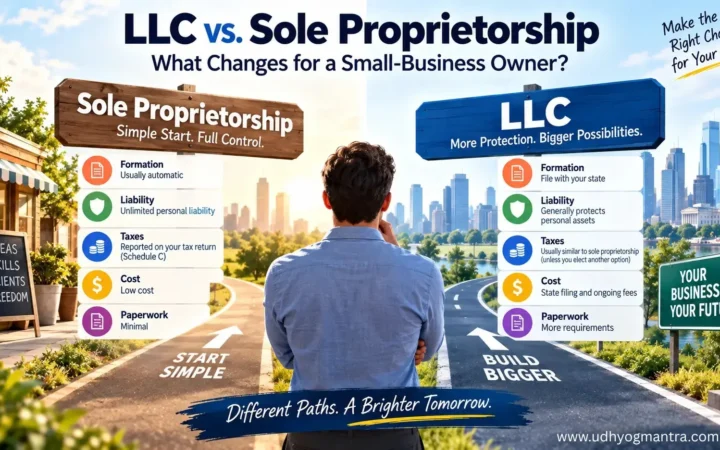
Should You Form an LLC Before Validating the Idea?
Not necessarily.
Some founders can test early demand before establishing a formal entity, particularly when the test involves research, interviews, prototypes, or other low-risk activities.
But legal, tax, contractual, regulatory, insurance, payment, and liability considerations depend on what you’re actually doing.
Selling food isn’t the same as interviewing people about food.
Taking customer deposits isn’t the same as showing a prototype.
Hiring workers isn’t the same as running a survey.
If you’re reaching the point where the business is becoming operational, our [LLC vs. sole proprietorship comparison] explains what changes when you move from operating individually to creating an LLC.
INTERNAL LINK #2
Anchor: LLC vs. sole proprietorship comparison
Target: LLC vs. Sole Proprietorship: What Changes for a Small-Business Owner?
Common Business Validation Mistakes
Asking Friends and Family
They may love you more than they love the business.
That’s a problem for research quality.
Asking Leading Questions
“Don’t you think this would save you tons of time?”
That’s sales disguised as research.
Treating Surveys as Proof of Purchase
Surveys can provide useful information.
But clicking “Yes, I’d buy” isn’t the same as opening a wallet.
Building the Entire Product First
If a landing page, manual pilot, prototype, or customer conversation can answer the question, use the cheaper test first.
Celebrating Vanity Metrics
Likes aren’t revenue.
Traffic isn’t revenue.
Followers aren’t revenue.
Waitlists are stronger, but still aren’t necessarily revenue.
Ignoring Negative Evidence
The entire purpose of validation is to find evidence that could change your decision.
If every result somehow proves you’re right, you aren’t validating.
You’re campaigning.
Testing Without a Decision Rule
Before starting, decide what result will cause you to:
- continue
- modify
- retest
- stop
Otherwise, you’ll be tempted to move the goalposts.
Business Idea Validation Checklist
Before investing significant money, can you answer these with evidence rather than optimism?
- Who exactly is the customer?
- What problem do they have?
- When did they last experience it?
- How frequently does it happen?
- What do they do today?
- What does the current solution cost?
- Who are the alternatives?
- Why would someone switch?
- Have you interviewed actual target customers?
- Have strangers shown meaningful interest?
- Have you tested a concrete offer?
- Have you tested a realistic price?
- Has anyone committed time, reputation, or money?
- Can you reach customers affordably?
- Can you deliver profitably?
- What assumption still creates the greatest risk?
- What evidence would make you stop?
If most answers begin with:
“I think…”
you probably need more validation.
What Comes After Validation?
Once the evidence is strong enough to justify the next investment, don’t immediately spend everything.
Move one level at a time.
For example:
Idea → Research → Interviews → Prototype → Paid Test → Small Launch → Measure → Expand
When you’re ready to move from validation into actual setup, follow our [12-step guide to starting a small business in the U.S.]
INTERNAL LINK #3
Anchor: 12-step guide to starting a small business in the U.S.
Target: How to Start a Small Business in the U.S.: A Practical 12-Step Guide
The principle is simple:
Increase investment as evidence improves.
Not before.
SUPPORTING IMAGE #3 — PLACE HERE
Concept: Decision graphic.
Only four large outcomes:
PROCEED | REVISE | PIVOT | STOP
Top text:
“What Does the Evidence Say?”
Use four clear arrows/icons. No descriptive subtext.
Filename: business-idea-validation-decision.webp
Alt text: Business idea validation decision framework to proceed, revise, pivot, or stop.
Final Takeaway: Don’t Prove Your Idea—Test It
The purpose of learning how to validate a business idea isn’t to eliminate uncertainty.
You can’t.
It’s to stop spending large amounts of money on questions you could answer cheaply.
Don’t begin with:
“How do I prove this idea will work?”
Begin with:
“What would have to be true for this business to work?”
Then identify the riskiest assumption.
Find the cheapest credible way to test it.
Talk to real customers.
Study what they already do.
Make a real offer.
Ask for meaningful commitment.
Check the economics.
And—this is the part founders hate—be willing to change your mind.
Because spending $100 to discover an idea needs work isn’t failure.
Spending $50,000 to discover something a $100 experiment could have told you is the expensive version of the same lesson.
Frequently Asked Questions
How Do I Validate a Business Idea for Free? (H3)
Start with free market research, competitor analysis, customer reviews and direct conversations with potential customers. Then test a simple offer through direct outreach or a manually delivered service. Some ideas can generate meaningful early evidence with almost no cash, although more complex businesses may require paid prototypes, samples, advertising, professional advice, or other costs.
How Many People Should I Interview to Validate a Business Idea? (H3)
There is no universal number. Start with enough qualified interviews to identify recurring patterns, then continue if new conversations are still producing materially new information. The appropriate depth increases with the cost and risk of being wrong. NSF’s intensive I-Corps National Teams program, for context, requires at least 100 customer and stakeholder interviews, but that is not a universal small-business benchmark.
What Is the Strongest Sign That a Business Idea Is Validated? (H3)
Observable customer behavior is generally stronger than stated interest. Depending on the business, a paid pilot, deposit, preorder, purchase, renewal, or repeat purchase can provide stronger evidence than survey responses or compliments.
Can a Landing Page Validate a Business Idea? (H3)
A landing page can help test positioning and demand, but traffic alone doesn’t validate the business. The page becomes more useful when it asks qualified prospects to take a meaningful action such as booking a call, requesting a quote, joining a relevant waitlist, placing a preorder, or beginning a paid pilot.
Should I Build an MVP Before Talking to Customers? (H3)
Usually, you can learn something before building an MVP. Customer interviews, competitor research and problem research can identify incorrect assumptions before development begins. When a product test becomes necessary, build the smallest version capable of answering the specific question you’re testing.
How Long Should Business Idea Validation Take? (H3)
It depends on the business. A simple service offer may produce useful evidence in days or weeks, while regulated, enterprise, manufacturing, scientific or capital-intensive businesses can require substantially longer validation. The right duration depends more on the evidence needed than an arbitrary number of days.